Introduction
Aqua Ball is an interactive instrument and sound installation built around a ball-shaped interface, embodied interaction, and an imagined ocean world. I recorded musical fragments through MIDI improvisation in Logic Pro, then used Max to layer samples, modulate their playback, and explore granular textures. Motion data from an IMU controls volume, playback speed, position, and effect parameters, making physical gestures part of the performance. By separating the control layer from the sound response layer, I made silence, changing textures, and sustained reverberation choices I could shape as I played.
Detailed Documentation
Motivation and references
Atau Tanaka’s Suspensions encouraged me to think about the relationship between the body and sound and inspired me to make an instrument of my own. I chose the ocean as a framework for improvisation, imagining possible sounds of marine creatures and natural objects and developing musical materials from those ideas.
The spherical design also came from my enjoyment of the round characters in Eggy Party. I felt that this shape could support different ways of holding and moving the interface, leaving room for improvisation. My observations and interpretations of Laetitia Sonami’s gestural performance practice also informed how I thought about moving between sections of a piece.
Ball interface and fabrication
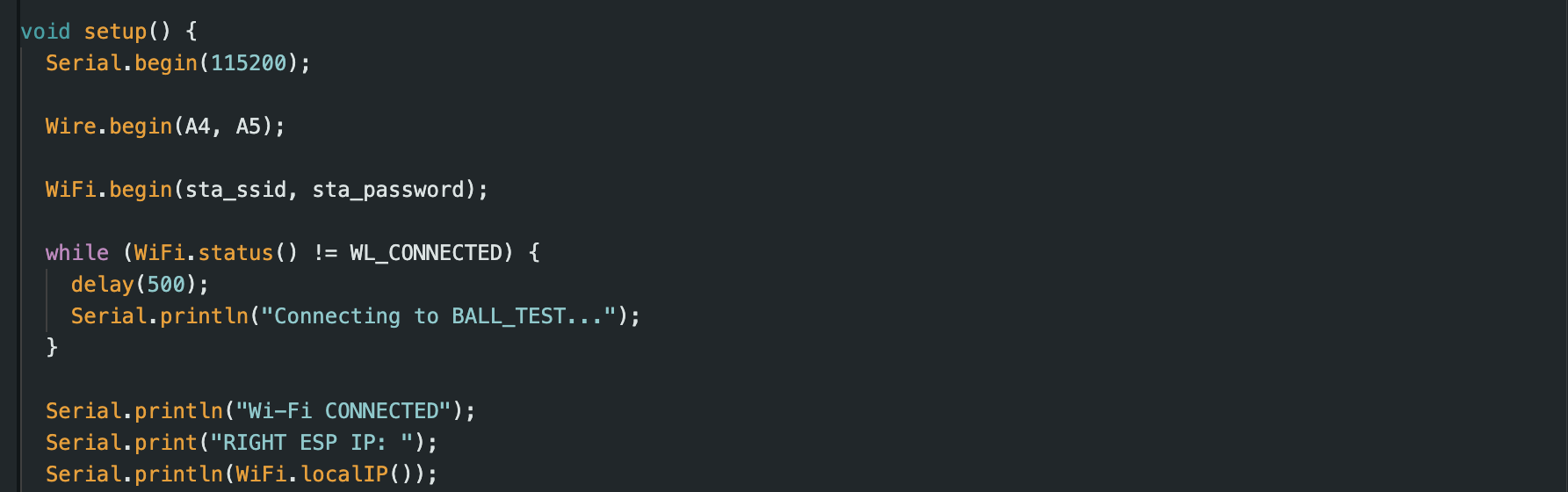
An IMU containing an accelerometer and a gyroscope captures motion data from the ball. Data read in the Arduino environment is transmitted to Max over Wi-Fi using OSC. I focused on how to process these values so that the same physical interface could take on different musical functions across the piece.
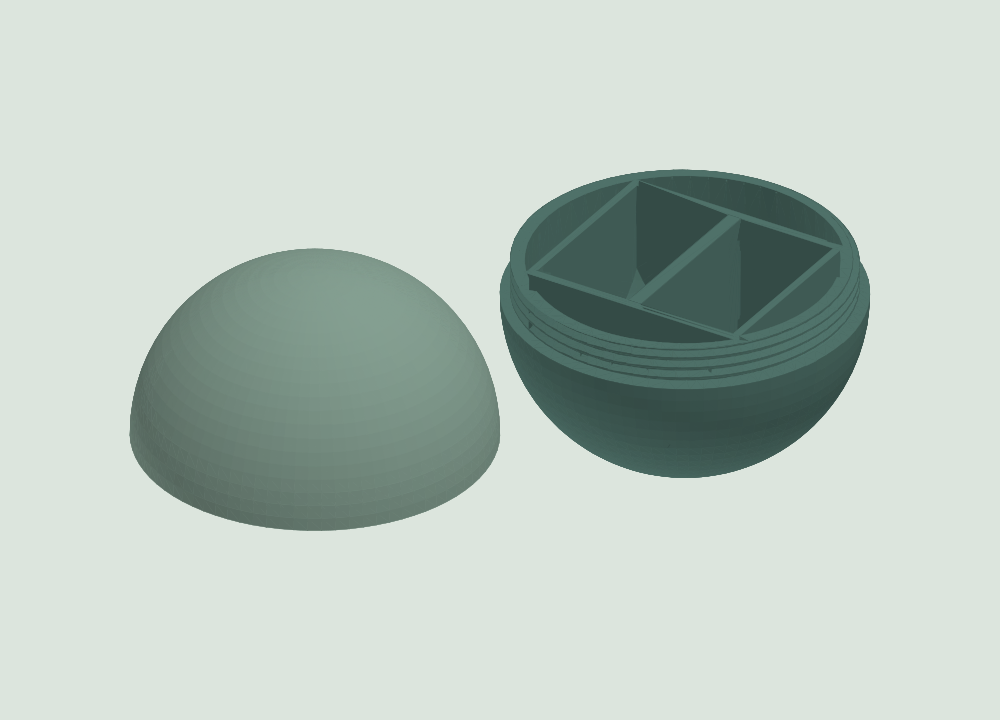
To retain a soft, graspable structure, I tested TPU in 85A, 90A, and 95A grades and selected 90A. During my own tests, data transmission continued with the 90A enclosure in place. I provided the ideas and design requirements for the structure, and Zhikang Xu carried out the 3D modeling.
Sound materials and Max workflow
This was my first attempt to develop sound materials through improvised recording. I recorded different fragments through MIDI improvisation in Logic Pro and then preprocessed them. Before recording, I had been concerned about harmonic relationships and clashes between the frequency ranges of different sounds. Working with these materials showed me how preprocessing could improve their relationships when layered and gave me more confidence to try uncertain combinations.
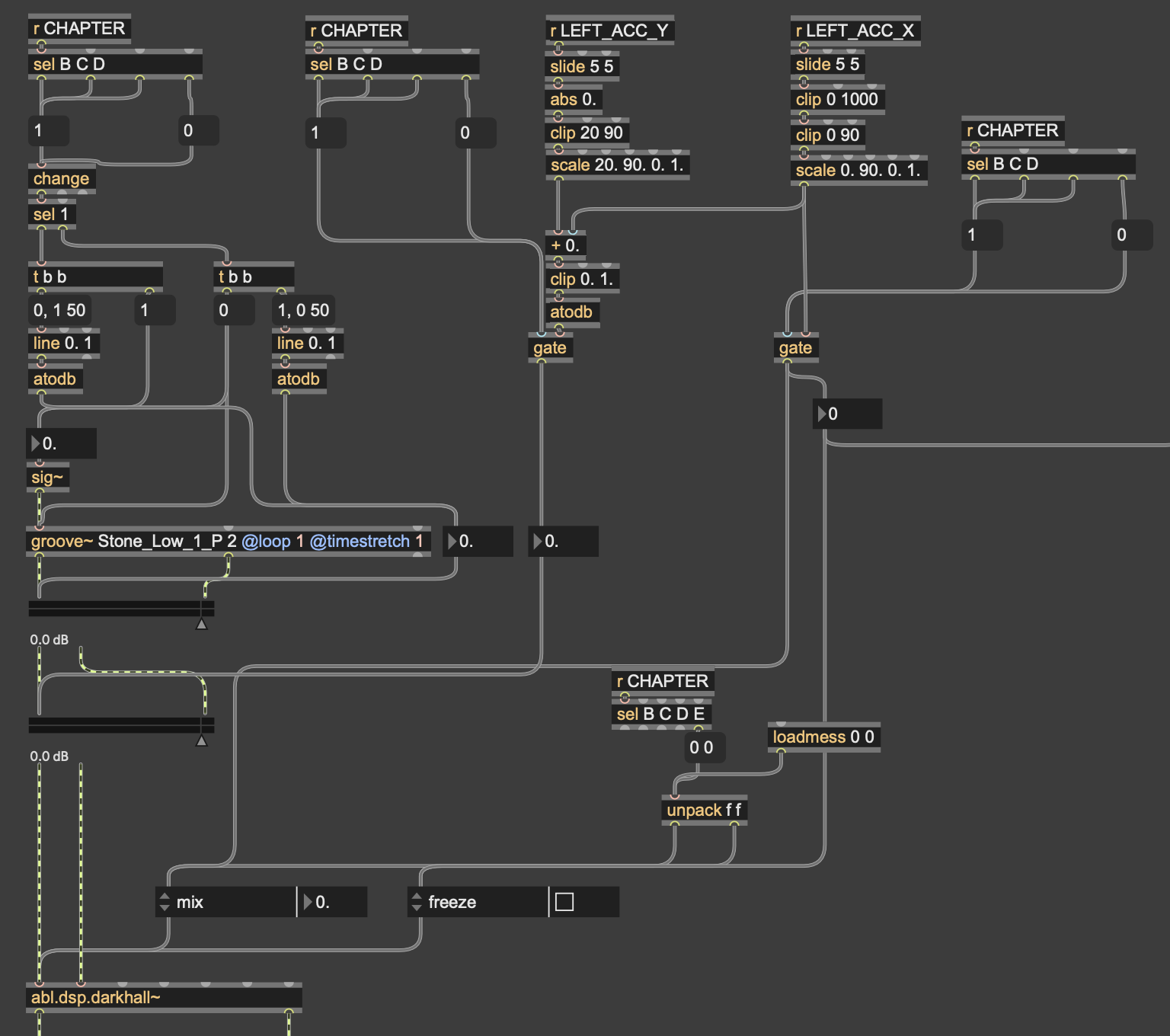
In Max, I organized the samples as a nonlinear, polyphonic structure and explored different ways of processing them. I used groove~-based sample playback and modulation to work with playback speed, position, and effect parameters, approaching these manipulations as a way to develop granular textures.
Motion mapping and sections
The system separates the control layer from the sound response layer. Acceleration data and control values such as roll and pitch are processed and mapped to sample and effect parameters. Their musical role changes with the active section and its control logic.
In the opening section of the performance, I created a muting operation based on Z-axis acceleration: returning the ball to a defined initial orientation allows me to silence the sound. Changes in acceleration as I tilt the ball, together with roll and pitch control values, shape the volume and position-based modulation of two base samples. Sound entering, falling silent, and changing locally all become part of the performance.
Motion data also contributes to section changes through logic in Max. I wanted the structure to leave room for improvisation while maintaining recognizable relationships between sections.
Improvisation and reflection
Before the final section, I created a transition that explores accumulation through feedback, reverberation, and freezing. I was drawn to the lingering quality that emerged through repeated processing, using reverb freeze to hold a sound texture temporarily. What is retained by each freeze depends on the performance leading up to that moment, allowing the same transition structure to unfold differently each time.
The process led me to treat sound processing as part of improvisation. Preprocessing helped the materials work together, while feedback and freezing continued to shape their behavior during performance. I could listen to those changes and use them to decide what to do next.
Contributions and tools
I developed the project concept, created the sound materials, and carried out the soldering and programming. Zhikang Xu completed the 3D modeling from my ideas and requirements. Throughout the build, I learned through Arduino tutorials and technical conversations with AI, applying that learning in my own fabrication and programming.
The main tools and materials include Logic Pro, Max, the Arduino environment, an IMU, and the TPU ball enclosure. AI served as a learning and technical support resource in this process.